




Your category is eating away your positioning!
At the ASIRT Synergy Biz Conclave last week, I sat through several presentations and had many conversations in between sessions.
Many founders presented on stage. But that was not the amazing part. What was amazing was what they said when someone asked them what their company does. Almost everyone said the same thing:
“We are a system integrator.”
And I felt for them. Because I know they have built real businesses, real teams, real client relationships and real expertise accumulated over decades. But the label they are using to describe all of that is working against them.
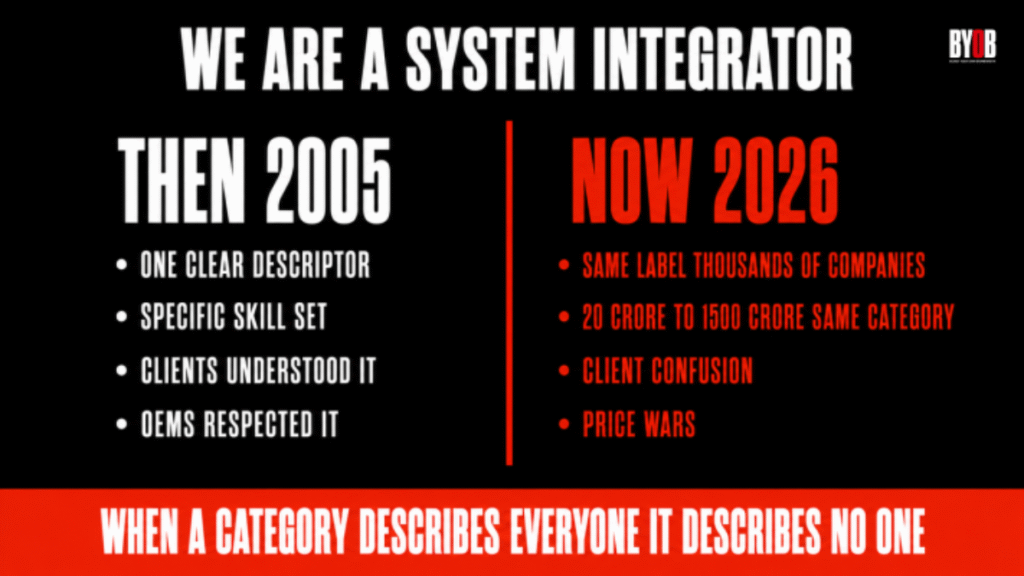
What happened to the SI category
20 years ago, being called a System Integrator meant something specific. It meant you could integrate complex technology environments.
You made servers, storage, networking, software etc. work together. That was a skill not everyone had back at that time.
- Clients understood it
- OEMs respected it
- The category had meaning
Today the same label describes a 20 crore reseller in Nagpur and a 1500 crore company with 800 engineers in Mumbai.
Same category. Completely different businesses.
When a category expands to include everyone, it stops creating differentiation.
That is where most IT channel founders are today. Trapped inside a category that used to give them identity and now gives them anonymity.
The distance problem
This is what most founders do when they feel this anonymity creeping in. They add more.
- More OEM partnerships
- More certifications
- More service lines
- More logos on the website
- More loss-making deals under pressure
The logic is understandable. If we do more things, more clients will find us relevant.
But what happens is quite the opposite. The more you try to cover, the harder it becomes for any specific client to understand why you are the right choice for their specific problem.
You are not creating distance from your competitors. You are moving closer to them.
Because they are doing the same thing. They are also adding more, covering more and claiming more.
And the client sitting across the table from both of you cannot tell the difference.
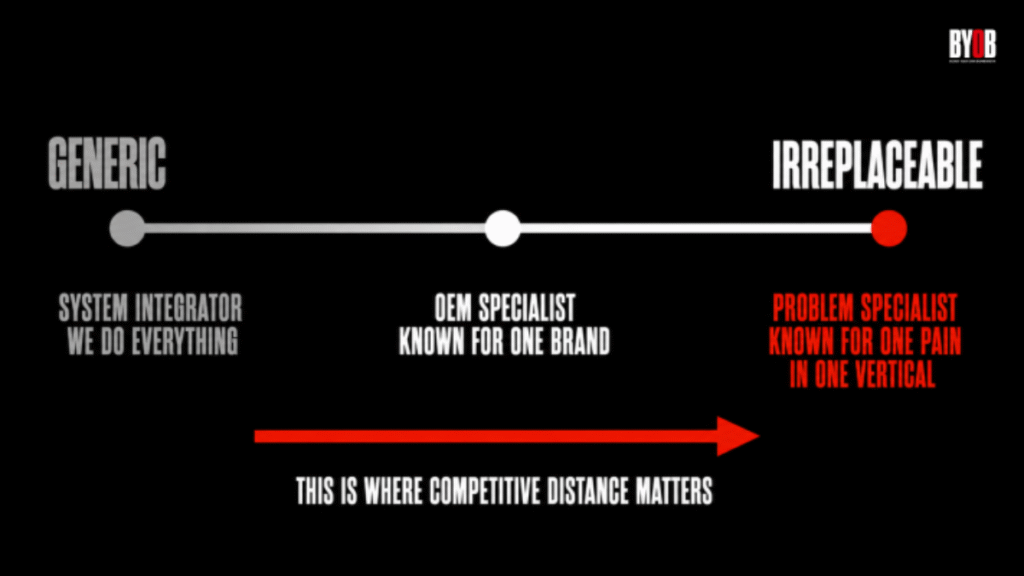
What competitive distance actually means
Distance = occupying a position that your competitors cannot credibly claim.
Not just slightly better. Genuinely different in a way that matters to a specific type of client.
A few examples from the Indian IT channel market that illustrate this:
- A partner who stopped calling themselves a system integrator and started positioning as the go to company for OT security in manufacturing plants. Their competitors cannot credibly claim that position without years of investment in that specific vertical.
- A VAD who stopped distributing everything and built deep specialization in identity and access management. Their channel partners now call them first for that specific conversation because they are further away from the generic crowd.
- A cybersecurity partner who built a managed detection and response practice when nobody in their city was doing it. Three years later, the OEM’s own team routes opportunities to them.
None of these companies became bigger. They became more distant from the confusion.
And distance, in a crowded market, is what gets you remembered.
The SI category is not your friend anymore
The SI category served a generation of founders well. It gave them a shared identity, a seat at the OEM table and a way to explain themselves to clients who were just beginning to understand technology procurement.
That era is over.
- Clients today are more informed
- Their problems are more specific
- Their budgets are more scrutinized
- And their patience for generic pitches is close to zero.
The founders who will matter in the next five years are not the ones who perfected the SI model. They are the ones who walked away from the category entirely and built something that stands apart.
Because they will make a decision about what they want to be known for. And they will stick with it long enough for the market to notice.
Positioning is not a one-time project. It is continuous discipline.
One more thing worth saying: Positioning is not something you do once and file away.
- Markets move
- Competitors copy
- Client expectations shift
- New technology waves create new opportunities and make old ones irrelevant
The founders who will stay relevant are the ones who will keep asking themselves this question:
Are we still creating distance? Or are we drifting back into the crowd?
That question, asked honestly and regularly, is what will keep a business sharp.
