




You are at an industry event. Someone from another company, maybe a client, maybe a OEM or even a peer, asks you a simple question: what makes you different from everyone else in this space?
You have built and run this business for twenty years, closed deals, survived downturns nobody younger in this industry has seen.
But ask yourself one honest question. When they asked you that, what did you actually say.
Most founders fumble right there. It is not because you do not know it. It is because for twenty years, the business worked well enough that nobody ever asked you to say it in exactly those words.
If you cannot define it, your team definitely cannot execute it.
Differentiation
This is the simplest one to say but the hardest one to answer honestly.
Differentiation is the real reason a client picks you over the other 10 vendors vying for the same pie.
- Not your certifications
- Not your brochure
- Not your website
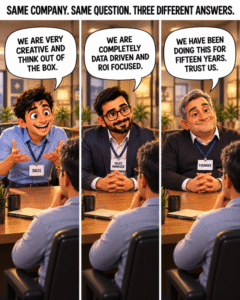
Most founders answer this with things every competitor can also claim.
- Quality service
- Strong team
- Customer first approach
- Bet in class support
That is not differentiation. That is everyone saying they are good.
Real differentiation is specific. It is rooted in how you actually operate, who you hire, or what you have lived through in this business that a newer player has not.
If your answer to differentiation could also be said by your competitor, it is not differentiation. It is a description of the whole category.
Positioning
Positioning is not a tagline.
Positioning is the decision about who you are built for and what specific problem you solve better than anyone else for that exact same person.
A company trying to be right for everyone ends up positioned for nobody. The client cannot tell if you are meant for them or not, so they default to comparing you on price.
Good positioning does the opposite. The right client meets you or your team, comes across your industry pages on your website or see you talking about certain pain areas in her/his industry and feels it calls for a more specific meeting.
Positioning is decided first internally. The words only come after that.
Elevator pitch
This is the compressed, spoken version of your positioning.
Thirty seconds, no slides, no jargon. Simple, clear language that can be understood by a layman.
Most founders think an elevator pitch is a rehearsed sales line. It is not.
It is a test. If you cannot explain what makes your business different in the time it takes to walk someone from floor 6 to ground in the elevator, you do not have clarity yet. You have a longer explanation that only sounds convincing with a full presentation behind it.
A strong elevator pitch does not need a deck to back it up. It stands on its own, in one breath.
Competitive mapping
This is not a list of who else sells the same OEM products as you. That’s the easy part.
Competitive mapping is understanding exactly where you sit against three or four real competitors your client is actually comparing you with, on the things that genuinely matter to that client.
- Speed
- Depth
- Relationship
- Price
- Reliability
Most founders skip this step and assume they already know their competition. But knowing a competitor’s name is not the same as knowing where you beat them and where they beat you.
Without competitive mapping, your differentiation is a guess. With it, your differentiation becomes provable.
Strategy
Strategy is the decision layer. Marketing is the execution layer.
- Strategy answers who you serve, what you will not do, and why you win
- Marketing takes that decision and turns it into a website, a deck, a LinkedIn presence
Most founders reverse this order. They start with marketing because marketing feels like progress. A new website looks like movement.
But marketing without strategy is just spraying and praying.
It is like an excellent photographs accorfing to you. It rarely performs, because there was never a real decision underneath it to communicate.
Strategy is not the fancy word for planning. It is the actual thinking that everything else depends on.

Why this matters even more today, twenty years into running your business
When you started this business, none of these five words decided who won a deal. A referral did. A handshake did. A track record client after client saw with their own eyes.
That still matters today. But the person across the table today checks you out before they ever pick up the phone.
They read your website first. They visit your LinkedIn profile to know about you. They compare you quietly against two or three others in the same category. They form an opinion before the meeting even starts.
Twenty years of experience is still your biggest asset. The only gap is that most of it still lives in your head, not on paper, where someone outside your business can read it and judge you fairly before they even meet you.
So the next time someone asks you what makes you different, at an event, across a client’s table, in a proposal meeting, you will already have the sentence ready.
And that will also help you with everything downstream – your website, your profile, your team’s answers to clients, your marketing team and your operations team. All of them finally agree on the same thing that will work for you.
Subscribe to the newsletter to stay sharp on what actually makes founders remembered.
Stop sounding generic. Be remembered.
